

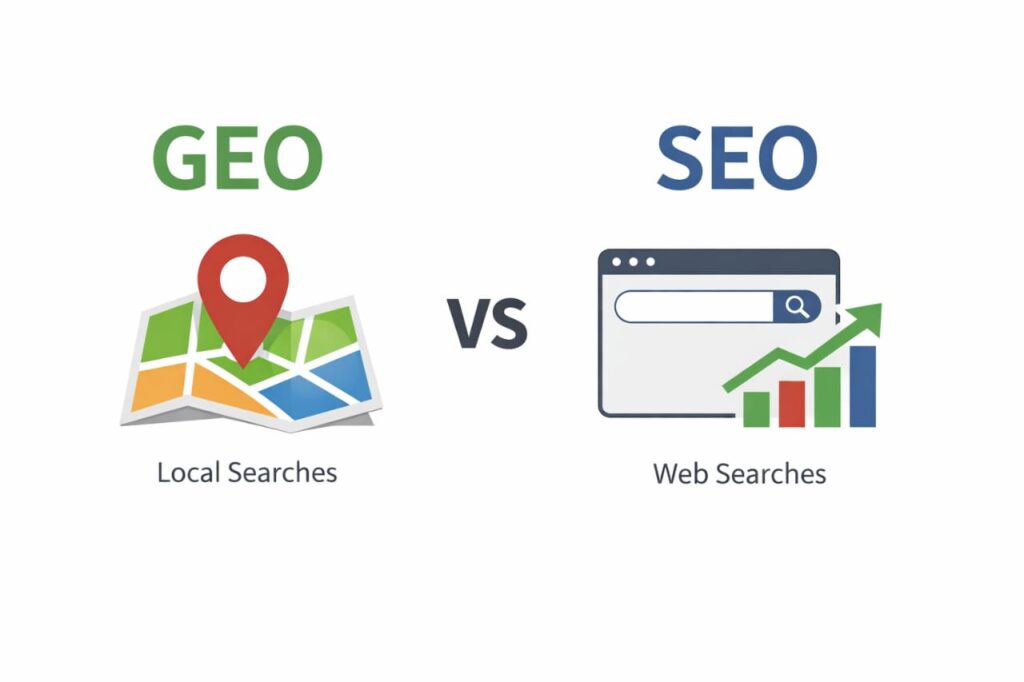
GEO vs SEO: What’s the Difference and Why It Matters in 2026
In the fast-evolving world of digital marketing, acronyms and strategies emerge and evolve every year — but two concepts remain universally important for businesses aiming to grow online in 2026: GEO and SEO.
While both are integral to driving traffic and conversions, they serve distinct purposes. Understanding the difference between GEO (Geographical Targeting) and SEO (Search Engine Optimization) — and how they intersect with the Google Helpful Content Update — can dramatically improve your digital marketing outcomes.
In this article, we’ll break down:
What GEO and SEO actually mean
How they differ
Why both matter in 2026
How the Google Helpful Content Update impacts them
How HSC Digital can help you win with both
What Is SEO?
Search Engine Optimization (SEO) refers to the practice of optimizing your website and content so that it ranks higher in organic search engine results for relevant keywords.
Fundamentally, SEO is about understanding what your audience is searching for, how search engines interpret your content, and how to make your pages more credible and relevant.
SEO focuses on several key areas:
Keyword research
On-page optimization
Technical SEO
Content quality
User experience
Backlinks and authority
In a nutshell, SEO is how you make sure your business gets found on search engines like Google, Bing, and DuckDuckGo when people type in questions, problems, or terms relevant to your products or services.
What Is GEO?
GEO stands for Geographical Targeting, and while it’s sometimes confused with SEO, it’s a distinct approach.
GEO refers to strategies that target users based on their physical location. It’s about showing the right message to the right people in the right place — whether that’s a city, country, region, or radius around your store.
Examples of GEO tactics include:
Geo-targeted ads (e.g., a Facebook ad only shown to people in Karachi)
Localized landing pages
Promotions based on city or region
Location-based keyword targeting in SEO
Store-level messaging and offers
GEO isn’t just about search — it intersects with PPC (pay-per-click), display advertising, social media, and even offline campaigns.
GEO vs SEO: What’s the Difference?
| Feature | SEO (Search Engine Optimization) | GEO (Geographical Targeting) |
|---|---|---|
| Main Goal | Improve organic search rankings | Target audiences by location |
| Focus | Keywords, content quality, site authority | Local relevance, location data |
| Primary Channels | Search engines | Search, display ads, social platforms |
| Success Metric | Organic rankings, traffic, engagement | Conversions in specific regions |
| Scope | Global or broad topic reach | Localized audience focus |
SEO answers the question: “How do I get found when people search for my offering?”
GEO answers: “Who should see my message based on where they live or search?”
In other words, SEO can help you be discoverable; GEO helps you be relevant — especially to local searchers and geographically segmented markets.
Why Both GEO & SEO Matter in 2026
1. Search Behavior Is More Personalized Than Ever
Today’s consumers expect personalized results — and that includes geographically relevant ones. Whether someone searches for “best cafés” or “plumber near me,” location plays a major role in their intent.
Combining SEO with GEO targeting ensures your business surfaces for both broad search queries and local, high-intent searches.
2. Mobile Search Dominates
Most searches today start on mobile devices. And mobile searchers are often looking for nearby solutions — e.g., stores, services, events, or urgent needs.
By layering GEO strategies on top of strong SEO foundations, you ensure your site appears in both:
Traditional search rankings
Local pack results
Map results
Geo-targeted ads
3. Local Competitors Are Investing Heavily in GEO
If you’re not optimizing for GEO now, your competitors are — and they’re capturing the customers you could be serving.
Local businesses that leverage both SEO and GEO are seeing better conversion rates, lower acquisition costs, and stronger customer loyalty.
4. Voice Search and Smart Assistants Are Geo-Sensitive
As voice search grows — with devices like Siri, Alexa, and Google Assistant — GEO becomes even more important.
Voice queries are often location-specific (e.g., “Where can I find a mechanic in Lahore open now?”), so integrating GEO into your SEO and content strategy is no longer optional — it’s essential.
The Google Helpful Content Update: What It Means for GEO & SEO
In the past few years, Google has increasingly prioritized content that’s helpful, relevant, and written for people — not search engines. This is the essence of the Google Helpful Content Update.
Key Principles of the Helpful Content Update
The update encourages content that is:
Written with real human needs in mind
Useful and informative
Comprehensive, not superficial
Free of manipulative or SEO-only tactics
Google explicitly aims to reward content that helps users solve problems, make decisions, answer questions, or complete tasks.
How the Helpful Content Update Impacts SEO
Before the update, many sites focused on keywords — often at the expense of actual usefulness. Now, Google looks for content that reflects:
Expertise
Credibility
Relevance
Depth
This means your SEO efforts must be guided by quality and user intent, not just ranking formulas.
SEO work today must include:
Audience research
Thorough topic coverage
Clear answers to real questions
Up-to-date and authoritative content
Search engines have become smarter — they’re essentially grading your content more like a human reader would.
How the Helpful Content Update Impacts GEO
For GEO targeting, the implications are equally significant. Google is now better at understanding a user’s location context, meaning:
✔ Local searchers will get more helpful, relevant content
✔ Businesses that tailor content for their region will rank better
✔ Generic content without geographical relevance will lose visibility
For example, instead of a generic “best restaurants in Pakistan” ranking globally, Google prioritizes content that helps local searchers in Karachi, Lahore, or Islamabad specifically.
The takeaway? Your localized content must be:
Specific to your audience’s location
Helpful to the people in that area
Written with their context and needs in mind
Best Practices for SEO + GEO in 2026
Here’s how to create a strategy that wins in 2026:
1. Understand Your Audience
Focus on real search intent. Ask:
What problems are users trying to solve?
What questions are they asking?
Where are they searching from?
Use tools like Google Search Console, analytics, and local keyword research.
2. Create Location-Specific Content
Generic content won’t cut it. Instead:
Write city or region-based pages
Mention local landmarks, customs, or events
Target localized search terms
Example: “Top cafés in Clifton Karachi” vs. “Best cafés in Pakistan”
3. Optimize for Local Search Features
Local features include:
Local map packs
Reviews
Google Business Profiles
Location extensions in ads
These are powerful drivers of traffic and leads.
4. Prioritize User Intent & Helpfulness
Every piece of content should serve a purpose:
Answer a question
Solve a problem
Provide clear takeaways
This aligns with Google’s Helpful Content algorithms — and improves rankings.
5. Use GEO in Paid Campaigns
Layer GEO targeting into your paid strategies:
Set radius targeting
Exclude regions where you don’t serve
Customize messaging for local seasons, holidays, or events
This improves ad relevance and ROI.
Why Businesses Need Strategic Support
SEO and GEO are not “one-time tasks” — they’re ongoing, technical, and strategic.
The digital landscape keeps changing:
Google updates algorithms constantly
User behavior shifts with technology
Local search becomes more competitive
Most businesses don’t have the time or expertise to manage this effectively on their own.
That’s where a specialist partner makes all the difference.
Why We Recommend HSC Digital
To truly succeed with SEO and GEO in 2026, you need a partner who understands both strategy and execution.
HSC Digital stands out because they:
- Build SEO strategies aligned with Google’s Helpful Content principles
- Create GEO-optimized content that resonates locally
- Focus on real user value, not ranking tricks
- Use data-driven insights to refine campaigns
- Boost visibility, conversions, and ROI
Whether your business is local, national, or global, HSC Digital can tailor a strategy that meets your goals — with clarity, transparency, and measurable impact.
Final Thoughts
In 2026, successful digital marketing is not just about being visible — it’s about being relevant, helpful, and contextual.
SEO helps you get found
GEO helps you get the right audience
The Google Helpful Content Update ensures search success is tied to quality and usefulness
Together, these create a powerful foundation for sustainable online growth.
If you want to compete — and win — in today’s search environment, you must think beyond keywords and rankings. You must create value.
And with the right strategy and support — like what HSC Digital offers — you can not only rank higher but connect deeper with your audience.